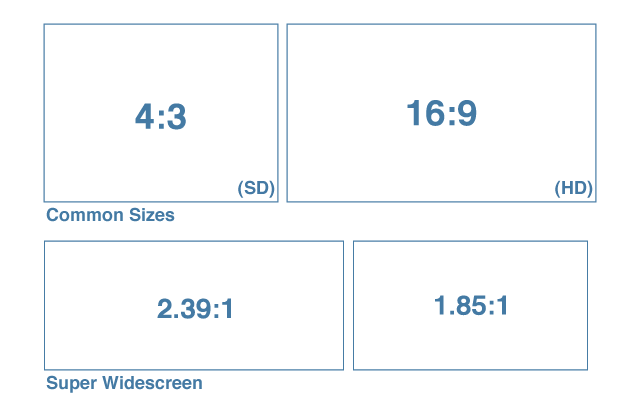
- Aspect Ratio - It is the relationship between the width and the height of your video dimensions expressed as a ratio. The most common aspect ratios are 4:3, 16:9, and 1.85:1.
- Bit Rate - It is the amount of data used for each second of the video. This is generally measured in kilobits per second (kbps) and can be constant or variable.
- Dynamic Range - It is the range of which a camera can successfully capture the lightest and darkest areas of an image without losing detail.
- Frame Rate - It is the rate at which a shutter opens and closes, or a sensor captures video during one second. Typical frame rates are 24, 30, 60.
- Resolution - It is a measure of the number of pixels a video contains booth horizontally and vertically. Some common resolutions are 640x480 (SD), 1280x720 (HD), 1920x1080 (HD). Sometimes these are referred to just by their vertical dimensions such as 480p, 720p, or 1080p.
- DSLR (Digital Single Lens Reflex) - This is a type of camera that uses a mirror to reflect the light coming through the lens onto the viewfinder.
HDMI (High-Definition Media Interface) - It is a digital connector prevalent across both consumer electronics and modern computers. HDMI carries both HD video and the audio signal to the TV.
Plasma Screens - They are comprised of hundreds of thousands of tiny gas-filled cells sandwiched between two sheets of glass. When an electric charge is applied to one of these gas-filled cells, it emits light, making up one of the thousands of pixels on-screen.
LCD (Liquid Crystal Display) - They are similar to Plasma screens, and comprised of a thin layer of special liquid crystals sandwiched between sheets of polarised glass or plastic. They don't emit light.
POV (Point of View) - It is a shooting technique that shows the perspective of a scene literally from a character or object's position in the setting.
Pixel Aspect Ratio - The width of each pixel relative to its height.
Timelapse - It is a technique where each frame in a video is captured at a much slower rate than normal. When played back at normal speed, time appears to go faster.
Wide Angle - It is a lens that uses a grouping of glass to enable a shorter focal length than the physical body of the lens would normally permit. The wide-angle lens can capture more of a subject from an equal distance when compared to a normal lens of the same size.
Digital Zoom - It is a method of giving an appearance of zooming without an actual optical lens change.


Comments
Post a Comment